Facebook
 X
 Pinterest
 Copy Link
The cost to buy a house in Hinsdale starts with the price, but the price is only the first number. Most buyers in 2026 are looking at listings with a median around $1.3 million, while detached single-family sales over the past year show a median closer to $1.425 million.
On top of that, you need a down payment, buyer closing costs, and a property tax bill that is often five figures a year. If you want one rule to remember, it is this: budget for the house, then budget again for getting into it.
A buyer with 20% down on a $1.3 million home needs $260,000 just for the down payment, plus roughly $26,000 to $65,000 in closing costs, before the first tax bill even arrives. The sections below break every part of that down, with examples, so you can see what your own number would actually look like.
Key Takeaways
- Hinsdale homes for sale in 2026 cluster around a $1.3 million listing median, with detached sales medians near $1.425 million. Entry-level detached homes generally start around $700,000 to $800,000.
- Buyer closing costs in Illinois typically run 2% to 5% of the purchase price, on top of your down payment.
- Property taxes vary by county: Hinsdale’s DuPage side shows a median effective rate near 1.75% and a median bill near $14,400, while the Cook County side shows about 2.03% and $18,772; always check the exact PIN.
- Hinsdale real estate prices are tiered: homes from $700,000 to $1,200,000 see the most competition, while homes above $2 million tend to sit longer and leave more room to negotiate.
- Never budget from a city median alone. Your price, your county, your loan, and your tax bill decide your real cost.
Hinsdale Real Estate Prices: What Homes Actually Cost in 2026
Hinsdale is DuPage County’s luxury market, and the prices show it. Listings data from November 2026 puts the estimated median home price at about $1,299,000 to $1,300,000, which lines up across several listing snapshots that month.
A separate local market guide, looking at detached single-family sales over the trailing twelve months in early 2026, puts the median sale price at about $1,425,000 and the average sale price at about $1,670,000. Those two medians measure different things, so do not treat either one as the only true number.
What matters for your budget is the tier you are buying in. The same local guide puts the entry point for a detached single-family home at roughly $700,000 to $800,000, usually for a smaller home that needs some updating.
The $700,000 to $1,200,000 range is where competition is fiercest, with multiple offers common on move-in-ready homes. Above $2 million, homes tend to stay on the market longer, which usually gives buyers more room to negotiate on price and terms.
That tiering is good news if you are flexible. If you can handle a home that needs work, or you can wait out a higher-priced listing, you may find more room than the headlines suggest. If you are set on a move-in-ready home in the most competitive tier, expect to move fast, offer cleanly, and have your financing and proof of funds ready before you tour.
| Price tier | What it usually means in Hinsdale | Competition |
| $700,000 – $800,000 | Entry-level detached home, often smaller or needing updates | High for well-priced homes |
| $800,000 – $1,200,000 | Move-in ready family homes, most buyer demand | Highest, multiple offers common |
| $1,300,000 – $2,000,000 | Around and above the median, larger or newer homes | Moderate |
| Over $2,000,000 | Luxury and estate homes | Lower, more negotiating room |
Total Cash Needed: Three Worked Examples
A price alone does not tell you how much cash you need on closing day. The table below uses a 20% down payment and the Illinois buyer closing-cost range of 2% to 5%, plus an estimated yearly tax figure using Hinsdale’s DuPage median effective rate of about 1.75%.
These are illustrations, not quotes, and your lender and title company will give you the exact figures for your deal. Read the table across, not down. At $800,000, you need about $176,000 to $200,000 in cash at closing, plus about $14,000 a year in taxes.
At $1.3 million, that jumps to about $286,000 to $325,000 at closing, plus about $22,750 a year in taxes. At $2 million, you are looking at roughly $440,000 to $500,000 at closing, plus about $35,000 a year in taxes, before insurance and any HOA dues.
| Purchase price | 20% down payment | Buyer closing costs (2%–5%) | Cash at closing (approx.) | Yearly taxes at 1.75% (approx.) |
| $800,000 | $160,000 | $16,000 – $40,000 | $176,000 – $200,000 | $14,000 |
| $1,300,000 | $260,000 | $26,000 – $65,000 | $286,000 – $325,000 | $22,750 |
| $2,000,000 | $400,000 | $40,000 – $100,000 | $440,000 – $500,000 | $35,000 |
If you put less than 20% down, your cash at closing falls, but your monthly payment rises, and most conventional loans will add private mortgage insurance until you build enough equity.
That trade can still be worth it if it gets you into the right home sooner, but do not let a lower down payment hide the full monthly cost. Ask your lender for the full payment principal, interest, taxes, insurance, and PMI, if it applies for each price you are considering, not just the loan amount.
Hinsdale Closing Costs: What Buyers Pay in Illinois
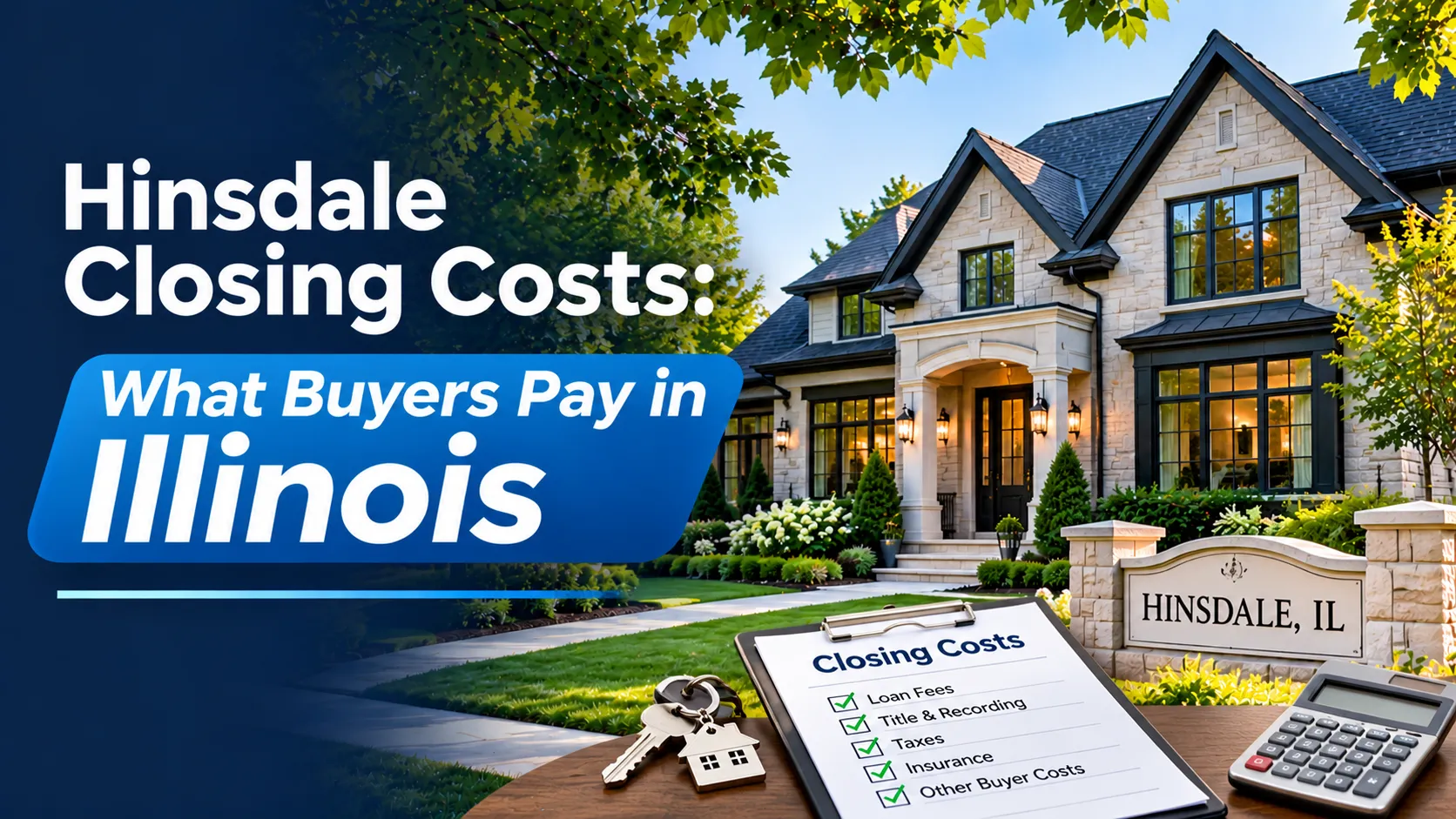
Hinsdale closing costs follow Illinois custom, and the buyer-seller split matters a lot here. Buyers in Illinois should generally budget 2% to 5% of the purchase price for their own closing costs, covering loan fees, title and closing services, attorney fees, inspections, recording fees, and prepaid items like insurance and taxes.
Sellers, by custom, pay the state and county transfer taxes and the owner’s title insurance policy, which is one reason buyer costs look lower than seller costs on paper.
Your lender must send you a final, itemised Closing Disclosure at least 3 business days before closing, so you get a chance to check every line before you sign. Do not skip that review, and do not assume the estimate you got at pre-approval is the final number.
Prepaid taxes and insurance, in particular, can move the total by thousands, and they are easy to miss until the disclosure arrives.
Loan, Title, and Attorney Fees
Loan fees are usually the biggest chunk of a buyer’s closing costs. Origination fees commonly run 0.5% to 1% of the loan amount, and you will also pay for an appraisal and, if you choose them, discount points to buy your rate down.
On top of that, your lender will require a lender’s title insurance policy, which one Illinois guide puts at roughly $595, separate from the owner’s policy the seller pays for.
Attorney fees are the other line buyers always ask about. Illinois does not legally require you to hire an attorney, but in practice almost every residential deal here uses one on each side. Buyer attorney fees commonly run $500 to $1,500 as a flat fee, with some guides citing up to $1,000 to $2,000 for a standard purchase depending on complexity.
Your attorney reviews the contract, checks the title commitment, handles the attorney-review window, and walks you through the loan documents at closing.
Inspections, Appraisal, and Prepaids
Inspections and appraisal are smaller lines, but they are not optional in most financed deals, and they protect you more than they cost. A home inspection, and in Illinois often a radon test as well, can surface problems that are far more expensive than the inspection fee, and the appraisal is what your lender uses to confirm the home is worth what you are paying.
Cash buyers can skip some of these, but even then, an inspection is usually money well spent in an older-home market like Hinsdale.
Prepaids are the part buyers forget most often. Your lender will usually collect several months of property taxes and homeowner’s insurance upfront into escrow at closing, on top of the fees above.
That is why two buyers with the same price and the same loan can still have different cash-to-close figures: the prepaid escrow depends on when you close and what your tax and insurance bills actually are.
Property Taxes in Hinsdale: DuPage vs Cook County
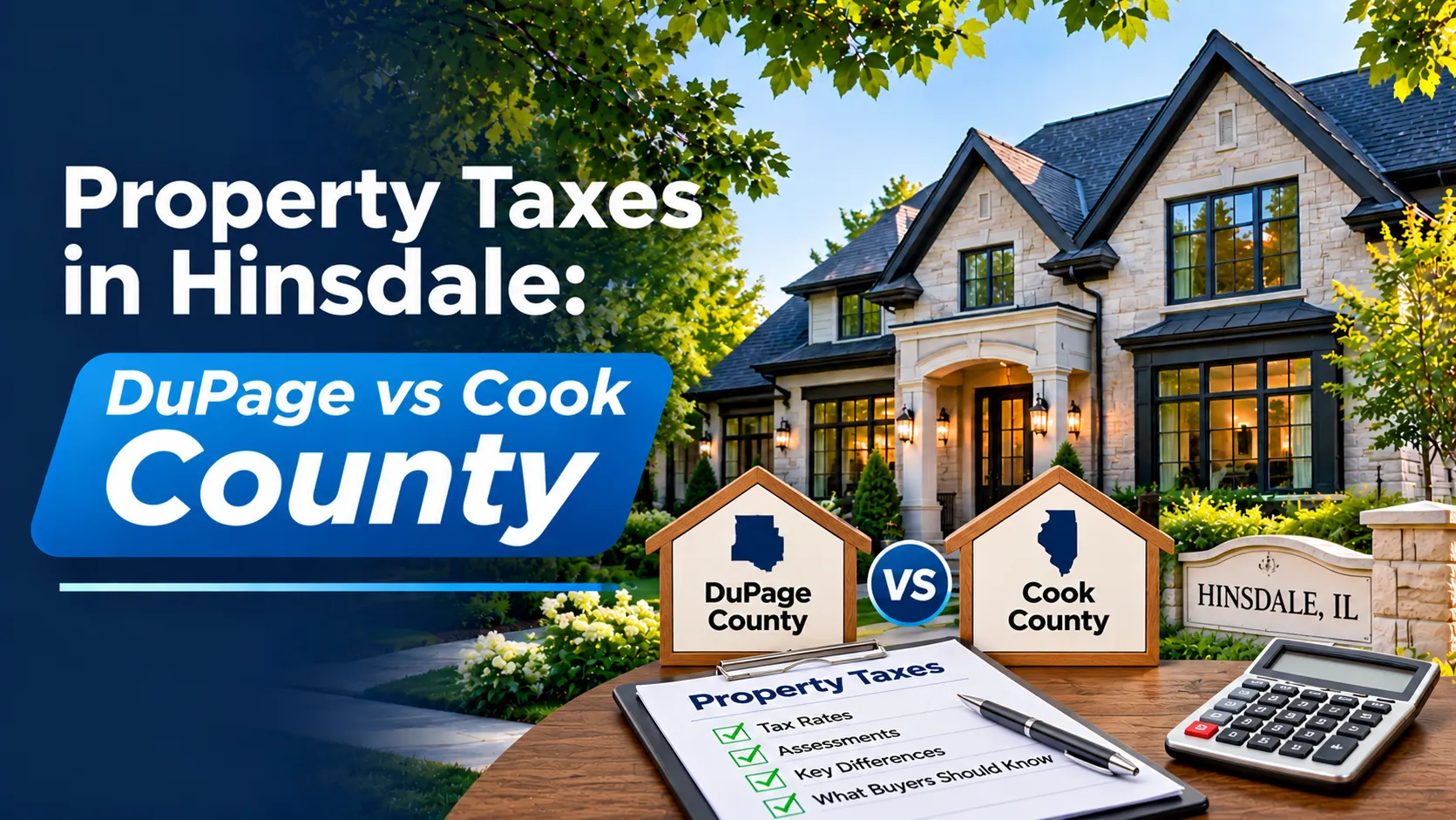
Property taxes are where Hinsdale buyers get the biggest surprise, because Hinsdale sits across two counties and the bills do not work the same way in each.
Most of Hinsdale is in DuPage County, where homes are assessed at one-third of market value, while the Cook County side assesses residential property at 10% of market value and then applies a state equalisation factor. That is why you cannot compare a DuPage tax rate and a Cook tax rate side by side; only the effective rate, as a share of market value, tells you the real burden.
For DuPage-side Hinsdale, one 2026 tax guide puts the median effective rate at 1.75% and the median annual bill at about $14,400, with a median home value in that dataset near $830,000. For Cook-side Hinsdale, the same source puts the median effective rate at about 2.03% and the median annual bill at about $18,772.
A separate 2026 Cook County guide lists Hinsdale at a 2.03% effective rate as well, which gives that Cook figure a useful cross-check, though the DuPage figure still needs checking against the actual parcel.
The only number that matters for you is the bill for the house you are buying. Pull the tax bill by PIN from DuPage County’s property lookup or the Cook County Assessor’s site, depending on which side of the line the home sits on, and ask your agent and attorney to confirm how much of the current year’s bill is prorated at closing.
Illinois taxes are paid in arrears, so the seller usually credits you for the days they owned the home, often calculated at 105% to 110% of the last bill as a cushion.
Down Payment, Monthly Payment, and Other Costs to Budget
Your down payment is the lever that moves everything else. At 20% down, you avoid private mortgage insurance on most conventional loans, but you tie up a lot of cash, as the examples above show.
With 10% or 5% down, you keep more cash in hand, but your loan is bigger, your monthly payment is higher, and PMI usually applies until your equity reaches the lender’s threshold. There is no single right answer here, only the answer that fits your cash, your income, and how long you plan to stay.
Beyond the mortgage, taxes, and insurance, budget for the costs that do not show up on a closing disclosure. Moving, utility setup, and immediate repairs all add up, and older Hinsdale homes can need updates even when they look perfect on a tour think roof, windows, mechanicals, and kitchens that were last done a generation ago.
If the home is in a subdivision with an association, add HOA dues to your monthly math as well, because those dues are easy to miss until you are already under contract.
What Drives Hinsdale Prices Up or Down
Schools are the first driver, and Hinsdale Central High School is a big part of the story. For the 2025-2026 school year, U.S. News ranked Hinsdale Central #9 in Illinois and in the top 302 nationally among public high schools, and the high school district is District 86.
Buyers pay for that reputation, and homes assigned to Hinsdale Central tend to hold their value even when the wider market cools, though your exact assignment still depends on the address, not the village name alone.
Location inside Hinsdale matters almost as much. Homes near downtown Hinsdale, with its walkable shops and restaurants, and near the Metra BNSF line to Chicago, tend to command a premium over homes further out, even at similar sizes.
Condition is the third driver: a renovated home in the competitive $800,000 to $1,200,000 tier can draw multiple offers, while an unrenovated home at the same price may sit, and a luxury home above $2 million gives buyers more room to negotiate because fewer buyers are competing for it.
Buying Luxury in Hinsdale Without Overpaying
Buying luxury home Hinsdale stock is a different game from buying an entry-level home, and the biggest mistake is treating them the same.
In the luxury tier, time is usually on your side: homes above $2 million tend to stay on the market longer, sellers are often more open to negotiation, and a careful inspection and appraisal matter even more, because a small percentage error on a $2 million home is a very large dollar error. Patience, in this tier, is often worth more than speed.
That does not mean you should lowball every luxury listing and hope for the best. Well-priced luxury homes still sell close to asking one local guide puts the overall list-to-sale ratio near 94% to 99% for well-priced homes and a seller who has already priced fairly will not move much just because you asked.
The smarter play is to anchor on recent comparable sales in the same part of Hinsdale, not on the list price, and to let your agent show you what similar homes actually closed for in the last six months.
Pre-Offer Cost Checklist
- Get a full lender estimate for your price, not just a pre-approval letter, including PMI if your down payment is under 20%.
- Pull the actual property tax bill by PIN and confirm which county the home is in DuPage or Cook.
- Ask for the Closing Disclosure timeline in writing: final figures at least 3 business days before closing.
- Budget inspection, appraisal, moving, and first-year repairs separately from your down payment and closing costs.
- Check HOA dues, if any, and add them to your monthly payment before you offer, not after.
- Compare at least three recent closed sales in the same Hinsdale area before you set your offer price.
Frequently Asked Questions
How much does it cost to buy a house in Hinsdale, IL?
Expect a median around $1.3 million for listings, and about $1.425 million for detached sales, plus 2% to 5% in buyer closing costs on top of your down payment. Run the numbers for the specific home, not the city median.
What is the median home price in Hinsdale?
Listings data from November 2026 puts the estimated median near $1,299,000 to $1,300,000, while detached sales over the past year show a median near $1,425,000. Check recent closed sales in your price tier before you budget.
How much are closing costs in Hinsdale?
Buyers in Illinois should budget 2% to 5% of the purchase price, covering loan fees, lender’s title insurance, attorney fees, inspections, recording fees, and prepaids. On a $1.3 million home, that is roughly $26,000 to $65,000, and your Closing Disclosure shows the exact figure 3 business days before closing.
How much are property taxes in Hinsdale?
They vary by county: DuPage-side Hinsdale shows a median effective rate near 1.75% and a median bill near $14,400, while Cook-side Hinsdale shows about 2.03% and $18,772. Pull the bill by PIN; county, district, and exemptions all change it.
Do I need 20% down to buy in Hinsdale?
No, but it helps. Less than 20% down means less cash at closing, a bigger loan, a higher monthly payment, and usually private mortgage insurance until you build enough equity. Compare the full monthly payment at 5%, 10%, and 20% down first.
Is Hinsdale worth the premium over nearby suburbs?
If top-ranked schools, a walkable downtown, and Metra access to Chicago are your priorities, many buyers say yes. If budget or space matters more, nearby suburbs may give you more house for the money compare the total monthly cost before you decide.
Final Guidance: What Should You Budget for Hinsdale?
If you are working out the cost to buy a house in Hinsdale, start with the tier, not the headline median. Pick the price range you can actually carry each month, with taxes and insurance included, then add your down payment and 2% to 5% in closing costs on top.
That order monthly payment first, cash at closing second keeps you from falling in love with a house whose tax bill you cannot comfortably carry.
Hinsdale rewards buyers who do the homework: check the PIN and the county, read the Closing Disclosure line by line, compare recent closed sales in the same area, and do not skip the inspection just to win a bidding war.
Do that, and the premium you pay buys you something real: strong schools, a walkable downtown, and a market with decades of demand behind it. Skip it, and the same premium can turn into a surprise you did not budget for.
Talk to The Haque Group for a buyer consultation, bring the homes you are comparing, and you will leave with a clear, home-by-home cost breakdown instead of a city-wide guess.